Call Now: 305-342-2535

How Much Does a Mobile Coffee Cart Cost? Complete 2026 Cost Breakdown
TL;DR
A mobile coffee cart can cost anywhere from a few thousand dollars for a lean DIY setup to $15,000 or more for a complete professional espresso cart. The cart itself is only part of the cost. Your espresso machine, grinder, water system, barista tools, transportation, and any equipment required by local regulations can easily cost as much as or more than the physical cart.
You do not need a $25,000 to $50,000 setup to start serving coffee at events. In our experience operating mobile coffee bars, keeping the setup simple and portable often makes more sense than building every possible feature into the cart.
How Much Does a Mobile Coffee Cart Cost?
There is a big difference between the cost of a coffee cart and the cost of a complete mobile coffee cart setup.
You might spend a few hundred or a few thousand dollars on the physical cart, but you still need an espresso machine, grinder, water system and barista tools before you can actually make drinks.
As a general starting point, we would think about the budgets like this:
| Type of setup | Approximate budget |
|---|---|
| Lean DIY coffee cart | $4,000 to $8,000 |
| Professional mobile espresso cart | $8,000 to $15,000 |
| Premium/custom setup | $15,000+ |
| Custom coffee trailer | Can reach $25,000 to $50,000+ |
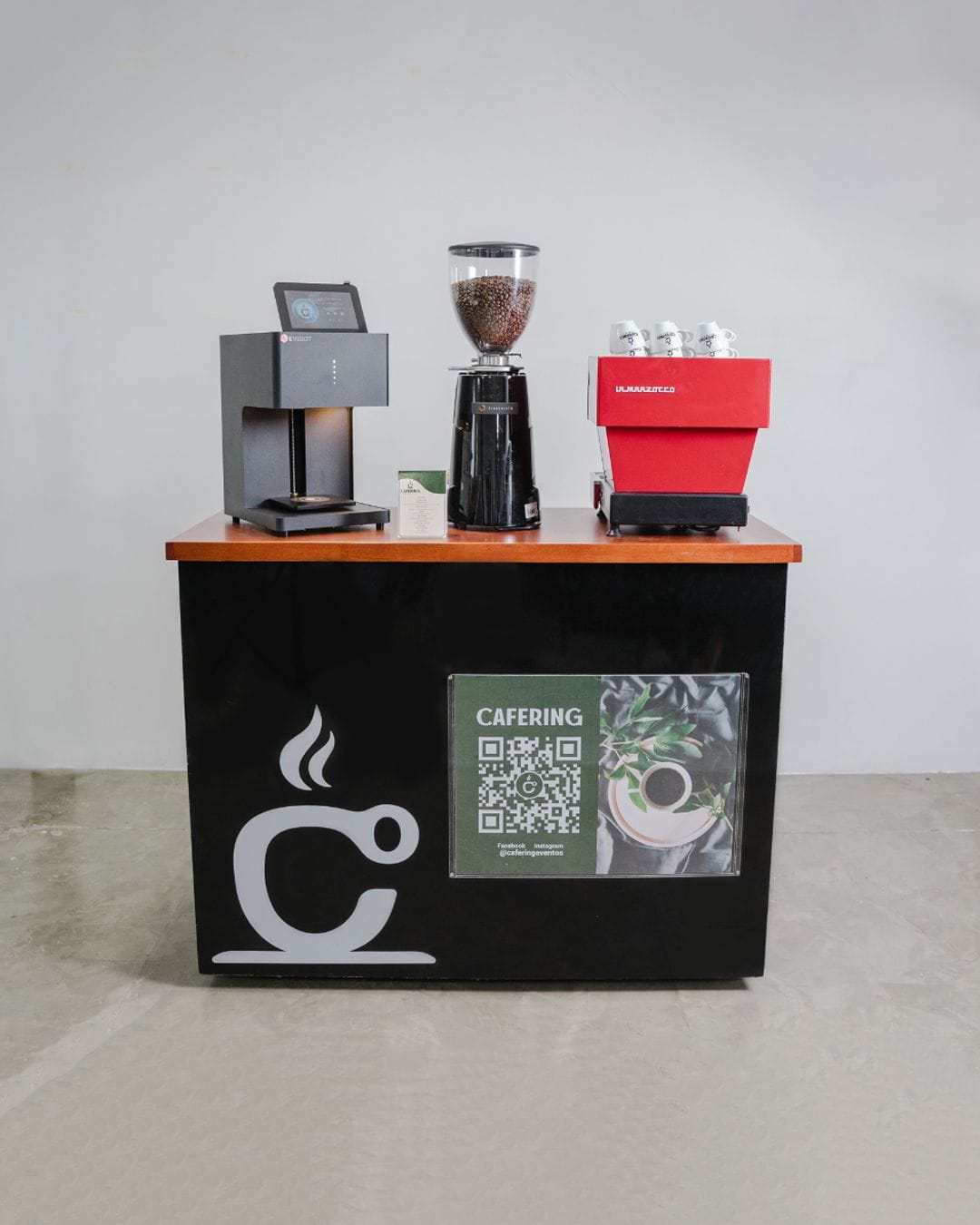
These are planning ranges, not fixed prices. Buying used equipment, converting an existing workstation, or already owning an espresso machine can dramatically reduce your startup cost.
At Cafering, our situation was unusual because my brother Mario already worked throughout the coffee industry, including operating coffee businesses and training baristas. We already had professional coffee equipment available that wasn’t always being used. Our startup cost therefore would not be a useful benchmark for somebody building a coffee cart completely from scratch.
What we have learned from actually operating coffee carts is that you don’t necessarily want the most elaborate cart you can afford. For event coffee service, portability and simplicity have real value.
Mobile Coffee Cart Cost Breakdown
Here is where the money actually goes.
The Coffee Cart: From DIY to $5,000+
The physical cart has one of the widest possible price ranges.
A cart does not necessarily have to be designed specifically for coffee. We have converted Husky workstations from Home Depot into coffee carts before. With some creativity, a sturdy workstation or similar piece of equipment can become the foundation of a functional mobile espresso bar.
There are also collapsible carts, custom-fabricated carts and complete purpose-built systems.
At the other end of the spectrum, purpose-built mobile coffee carts can cost several thousand dollars before you put an espresso machine on them. For example, Simple Cart Systems currently lists several of its cart models starting at $2,795, while its “Essential Cart” configuration with its water/electrical HUB starts at $4,840.
Caffewerks lists an empty custom cart at $3,835 before freight, while its complete road-case coffee cart build is currently $9,050.
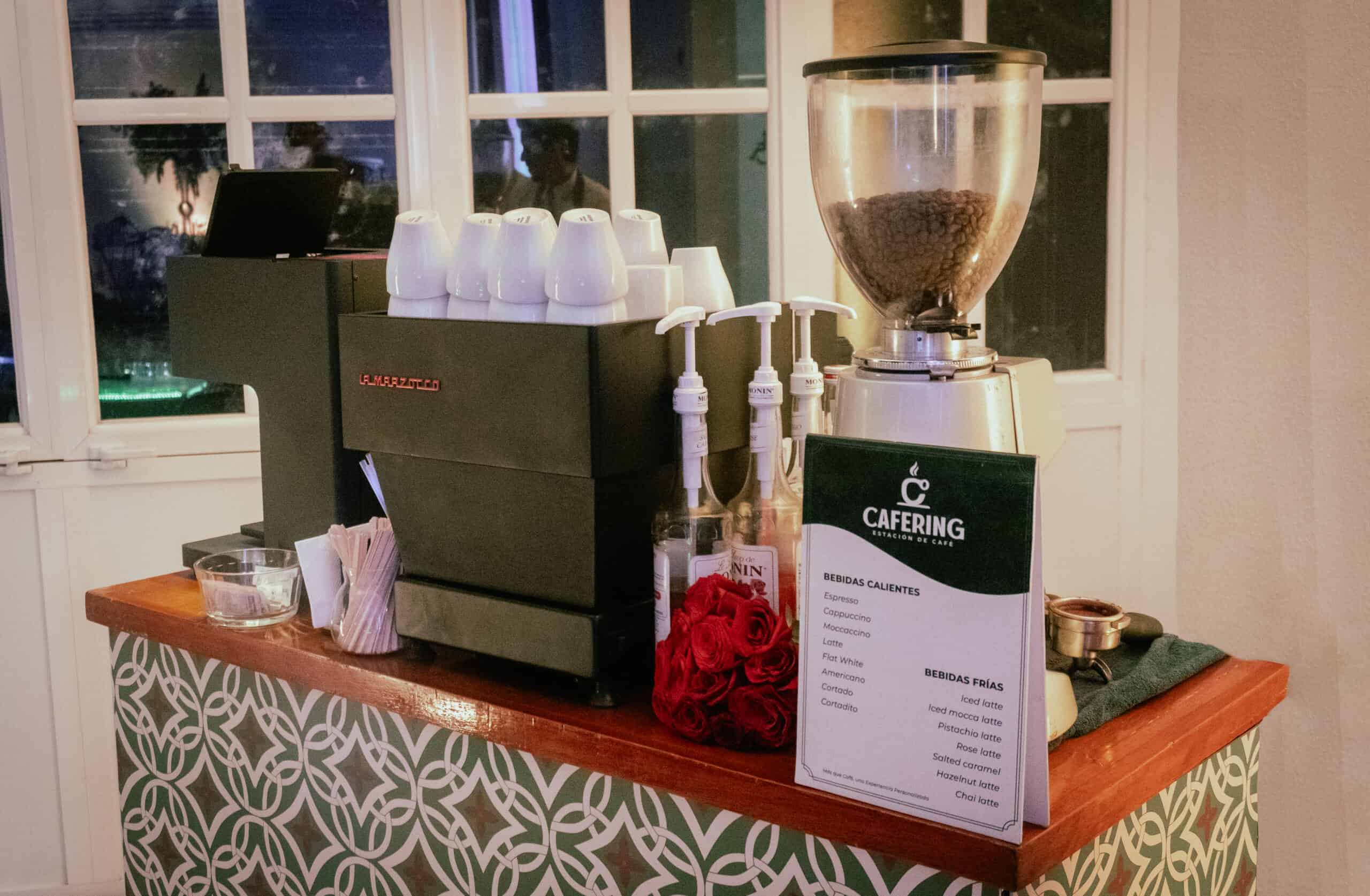
The lesson is not that you should spend $4,000 on a cart. It’s that the cart shell can be as simple or elaborate as your operation requires.
For a new event coffee business, we would generally rather put money into reliable coffee equipment than cabinetry and features that don’t improve the drinks or make service easier.
Espresso Machine: Roughly $2,000 to $7,000+
The espresso machine can be the largest individual expense.
There are less expensive machines from brands such as Breville that can lower the barrier to entry. On the professional side, machines commonly considered for mobile applications include the LUCCA A53 line, La Marzocco Linea Mini and La Marzocco GS3, among many others.
At Cafering, we use La Marzocco Linea Minis on our coffee carts.
A new Linea Mini currently starts at $6,600. It is a compact dual-boiler machine with PID temperature control and professional-level temperature stability.
That is a significant investment, but its relatively compact footprint is useful on a cart where every inch matters.
You don’t necessarily need to spend that much. Buying a good used espresso machine can reduce the cost considerably, and a lower-priced machine may be completely reasonable when you’re getting started.
Going substantially larger or more expensive isn’t automatically an improvement either. A machine like the GS3 can be excellent, but on a mobile setup you also have to think about its size, weight, power requirements and whether the additional capability actually benefits your operation.

The question should be: what is the simplest machine that can reliably handle the volume and drink quality I need? Not: what is the most expensive machine I can fit on the cart?
Espresso Grinder: About $1,000 to $2,500+
Don’t spend thousands on an espresso machine and then make the grinder an afterthought.
We use Fiorenzato grinders, but there are plenty of viable commercial options from manufacturers such as Fiorenzato, Mahlkonig, Anfim and others.
As one current reference point, Simple Cart Systems sells the Anfim Luna for $1,449.
For planning purposes, roughly $1,000 to $2,500+ is a reasonable range for a serious espresso grinder, although you can certainly find options outside it.
If you’re trying to start lean, this is also an area where good used equipment can make sense.

Water and Plumbing: A Few Hundred to $2,000+
A coffee cart usually doesn’t have the luxury of sitting next to a permanent water line.
You need to think about:
- Fresh water
- Waste water
- Supplying the espresso machine
- Pitcher rinsing
- Pumps, tubing and fittings
- Where everything goes inside the cart
We’ve used mobile plumbing components from Caffewerks and Decent Espresso.
Caffewerks currently offers complete cart-component water systems starting around $570 to $651 depending on the intended volume.
Decent takes an interesting approach to mobile coffee carts. Its system can use an IKEA BROR cart and adds components such as a pitcher rinser, knockbox, water uptake and drainage equipment. Decent also makes a catering kit specifically for pulling water from a portable water tank into its espresso machines.
At the more integrated end, Simple Cart Systems’ HUB package starts at $1,870 and includes its water and electrical components.
You don’t necessarily need the most sophisticated option.
For event coffee carts, we like keeping things relatively simple. Fresh and waste tanks, reliable plumbing and a pitcher rinser can accomplish a lot without turning the cart into a miniature commercial kitchen.
Barista Tools and Small Equipment: $100 to $1,000+
This is the category people forget because no individual item seems particularly expensive.
At minimum, you may need things like:
- Tamper and tamping mat
- Milk pitchers
- Espresso scale
- Knock box
- Barista towels
- Cleaning brushes and espresso-machine cleaner
- Water containers
- Waste-water container
- Extension cords
- Storage bins
- Syrup bottles and pumps, if applicable
- Spare gaskets and small replacement parts
You don’t have to buy the most expensive version of everything.
As a current comparison, Simple Cart Systems sells an essential barista tool bundle for $99 and a more extensive bundle for $420. Its $420 bundle includes an Acaia Lunar scale, pitchers, cloths, shot glasses and mats.
If you’re starting from zero, I’d leave several hundred dollars in the budget for all of the little things rather than assuming the machine, grinder and cart are the entire investment.

What Is the Cheapest Way to Build a Mobile Coffee Cart?
The cheapest practical approach is usually to keep the cart simple and spend money where reliability actually matters.
A lean setup could consist of:
- A converted workstation or inexpensive collapsible cart
- A capable espresso machine, potentially purchased used
- A reliable grinder
- Portable fresh and waste water tanks
- A pump and simple plumbing system
- A pitcher rinser
- Essential barista tools
- A cooler for milk and ice
We’ve personally converted Husky workstations into coffee carts.
Decent’s use of IKEA BROR workstations for its own cart system is another example of the same general idea: the piece of furniture underneath your espresso machine doesn’t necessarily need to have started life as a $5,000 specialty coffee cart.
You can always improve the appearance, branding and workflow as the business grows.
How Much Should You Budget for a Professional Event Coffee Cart?
Here are three hypothetical builds to make the numbers easier to understand.
Lean Build: Approximately $4,000 to $8,000
This assumes some combination of:
- DIY, converted or inexpensive cart
- Lower-cost or used espresso machine
- Capable grinder
- Simple portable plumbing
- Fresh and waste tanks
- Essential tools
- Cooler for milk and ice
The biggest variable is the espresso machine. Finding quality used equipment can move the total substantially.
Professional Build: Approximately $8,000 to $15,000
A professional setup might include:
- Higher-quality collapsible or custom cart
- Professional espresso machine
- Commercial grinder
- Reliable pump and water system
- Integrated pitcher rinser
- Quality barista tools
- Proper power cables and accessories
- Transport and storage equipment
For perspective, combining a new $6,600 Linea Mini with a roughly $1,500 grinder already puts you above $8,000 before purchasing the cart or plumbing.
A complete setup can therefore cross $10,000 very quickly without being extravagant.
Simple Cart Systems provides another useful real-world benchmark. Its current complete cart package is $7,547 without the espresso machine and grinder. A complete package including a Sanremo YOU and grinder is $16,446.
Premium Custom Build: $15,000+
Once you start adding expensive custom fabrication, integrated electrical systems, sinks, refrigeration, multiple grinders, premium machines and other equipment, there really isn’t a meaningful ceiling.
But spending more doesn’t necessarily create a better mobile coffee cart.
Every addition has consequences.
Why We Prefer Keeping Mobile Coffee Carts Simple
One thing we’ve learned from coffee cart catering is that mobility itself has value.
Suppose you permanently install a refrigerator in the cart. Now you’ve added weight, taken up space, created another electrical requirement and added another component that can fail.
For many events, a good cooler with ice accomplishes the same basic job with much less complexity.
We think similarly about sinks.
A pitcher rinser is extremely useful for an espresso cart. A full sink may not provide enough additional operational value to justify the space, weight, plumbing and electrical requirements unless your particular operation or local regulations require one.
For comparison, Simple Cart Systems charges $825 for its sink and hot-water package, and the included water heater alone draws 1,300 watts.
That doesn’t make a built-in sink bad. It means you should have a reason for adding it.
This principle applies throughout the cart: don’t permanently add equipment merely because you can. Add it because it solves a real problem.
What About Local Health Department and Permit Requirements?
This is the major exception to the “keep it simple” philosophy.
What you personally need and what your local regulations require can be two different things.
Depending on where and how you operate, applicable rules may require specific sinks, potable-water capacity, waste-water capacity, refrigeration, food-safe surfaces or other equipment.
Those requirements vary by jurisdiction and business model, so check the applicable local health department, licensing and fire requirements before finalizing the design of your cart.
You don’t want to spend thousands building the perfect minimalist cart and then discover that your operating model requires equipment you didn’t leave room for.
Sometimes mobile coffee operations simply require creative solutions. The important part is finding the simplest compliant setup that still lets you work efficiently.
Optional Equipment You Probably Don’t Need on Day One
There is almost no limit to what you can add to a coffee cart.
You could add:
- Built-in refrigeration
- Full sink and hot-water system
- Automatic tamper
- Additional grinders
- Coffee printer
- Custom cabinetry
- Extensive integrated electrical
- Additional espresso machine
- Built-in ice storage
- Elaborate lighting and displays
Some of these can make sense. We use coffee printers for certain branded events, for example.
But they shouldn’t automatically be included in your calculation of what it costs to start a mobile coffee cart.
A branded activation serving hundreds of drinks has different requirements from somebody booking their first 50-person private event.
Start with what solves your immediate operational needs. You can buy additional equipment once you have a reason to use it.
Costs New Coffee Cart Owners Often Forget
The equipment purchase isn’t the end of the expenses.
Insurance is one obvious cost. If you’re serving at venues and corporate events, you’ll commonly encounter insurance requirements.
Transportation matters too. A beautiful cart isn’t very useful if you can’t reliably get the cart, machine, grinder, water, ice, milk and supplies to an event.
Then there’s storage.
At first, keeping a cart and some supplies in your house or garage may be completely manageable. As you start doing more events, suddenly you’re storing carts, cases of cups, milk, syrups, equipment, cleaning products, spare parts and everything else required to operate.
Eventually, warehouse or dedicated storage space may become worthwhile.
The same thing happens with ice and refrigeration. Supplying one small event is easy. Supplying multiple events creates a logistics problem that didn’t exist when you started.
There are also ongoing costs for:
- Espresso-machine maintenance
- Grinder burrs and maintenance
- Cleaning products
- Replacement plumbing components
- Broken tools
- Cups and lids
- Coffee
- Milk and alternative milks
- Ice
- Syrups and other ingredients
- Water
- Fuel and transportation
- Equipment storage
These aren’t reasons to overbuild your first cart. In many cases, they’re reasons to do the opposite.
Keep the initial operation lean until the business itself tells you what you actually need.
Do You Need to Spend $20,000 to $50,000 on a Mobile Coffee Cart?
No.
You certainly can spend that much, but there is a major difference between a portable mobile espresso cart and a completely built-out coffee trailer or highly customized mobile cafe.
If the goal is coffee catering for events, a professional espresso machine, capable grinder, reliable water system, good workflow and the basic tools to make drinks are far more important than having every possible feature built into the cart.
Our preference is to start with the simplest setup that can reliably do the job.
Then let actual events tell you what needs to be added.
If you’re constantly running out of cold storage, solve that problem. If your machine can’t keep up with volume, upgrade it. If a permitting requirement demands a sink, add the appropriate sink.
Don’t build a $30,000 solution to problems you haven’t encountered yet.

Ready to skip building your own cart?
We already run the espresso machines, grinders and carts described in this article at events across Miami, Broward and Palm Beach. Bring us in instead of building it yourself.
Get a Quote