Call Now: 305-342-2535

What Is a Normal Price for Coffee?
The short answer
In the United States, a normal coffee-shop price is about $3 to $4.50 for brewed coffee and $4.50 to $6.50 for a latte. Convenience-store coffee can cost under $3, while elaborate specialty and luxury drinks may cost $7 to $12 or more. Making coffee at home usually costs between $0.20 and $1.50 per cup before accounting for equipment.
A normal price for coffee in the United States is approximately:
| Type of coffee | Normal price |
|---|---|
| Convenience-store or fast-food coffee | $1.50 to $3 |
| Coffee-shop brewed coffee | $3 to $4.50 |
| Americano | $3.50 to $5.50 |
| Latte or cappuccino | $4.50 to $6.50 |
| Cold brew | $4.50 to $6.50 |
| Flavored specialty latte | $5.50 to $8 |
| Matcha latte | $5.50 to $8 |
| Single-origin pour-over | $5 to $10 or more |
| Luxury or elaborate signature drink | $8 to $12 or more |
| Coffee made at home | $0.20 to $1.50 |
These are reasonable U.S. ranges in 2026, not fixed prices. City, serving size, ingredients, business model, and location can change the price considerably. Tax, tips, delivery fees, and customizations may also increase the final amount.
What Is the Average Price of Coffee at a Coffee Shop?
For an ordinary cup of brewed coffee, approximately $3 to $4.50 is normal. A latte is more likely to cost between $4.50 and $6.50.
Toast‘s coffee pricing analysis found an average latte price of approximately $5.60. Its average macchiato price was $5.11. Those figures provide a useful national reference, although individual menus vary by market.
A $3 brewed coffee would be inexpensive but normal. A $4 coffee would sit near the middle of the market. Once a basic brewed coffee reaches $5 or more, customers may expect something extra, such as better beans, a larger serving, an expensive location, or a carefully prepared single-origin coffee.
Normal Coffee Prices by Type
Brewed coffee
A standard drip coffee normally costs $2.50 to $4.50. Fast-food restaurants and convenience stores tend to be near the lower end. Independent cafés in major cities are more likely to charge toward the upper end.
The drink is simple, but the customer is paying for more than the grounds and water. The price also supports labor, rent, utilities, equipment, cups, cleaning, waste, and the convenience of having the coffee prepared immediately.

Espresso and Americanos
A single or double espresso commonly costs $3 to $4.50. An Americano often costs $3.50 to $5.50.
Although these drinks use fewer ingredients than a latte, they still require an espresso machine, grinder, trained staff, and preparation time.
Lattes and cappuccinos
A normal latte or cappuccino costs approximately $4.50 to $6.50. Larger sizes, alternative milks, extra espresso shots, syrups, cold foam, and other customizations can bring the total to $7 or more.
These drinks cost more because they require espresso, milk, additional preparation, and more expensive equipment than ordinary drip coffee.
Cold brew
Cold brew usually costs $4.50 to $6.50. It often requires more coffee grounds, a long brewing period, refrigerated storage, and advance preparation.
Nitro cold brew can cost slightly more because it requires additional equipment and nitrogen service.
Specialty and flavored drinks
A flavored latte, seasonal drink, matcha latte, or elaborate iced coffee commonly costs $5.50 to $8.
The higher price may reflect syrups, sauces, toppings, alternative milk, multiple espresso shots, branded packaging, and additional labor. These drinks also tend to be among the most profitable menu items because customers are less likely to compare them directly with plain coffee.

Pour-over and rare coffee
A handmade pour-over might cost $5 to $10. Coffee made with rare beans, unusual processing methods, or competition-grade lots can cost considerably more.
In this category, customers are paying for the coffee’s origin, traceability, roasting, small-batch preparation, and the time required to make one drink individually.
Convenience Store vs. Café vs. Specialty Coffee
The same general beverage can have very different prices depending on where it is purchased.
Gas stations and convenience stores
A normal price is around $1.50 to $3.
These businesses can keep prices lower through self-service, large-volume brewing, simpler menus, less expensive locations, and coffee that encourages customers to purchase other products. Prices vary by location, as even 7-Eleven notes on its coffee information rather than publishing one nationwide price.
Fast-food restaurants
A basic coffee commonly costs $1.50 to $3.50. Espresso and iced drinks usually cost more.
Large chains benefit from high volume, centralized purchasing, simplified preparation, and coffee sales that support breakfast purchases.
Standard cafés
Expect to pay approximately $3 to $6.50, depending on the drink. You are also paying for seating, atmosphere, service, convenience, Wi-Fi, and access to the café’s space.
Specialty cafés
Specialty cafés commonly charge $4 to $8 for standard menu drinks and more for rare coffees.
They may purchase higher-quality beans, work with smaller roasters, pay more attention to sourcing, adjust recipes throughout the day, and employ baristas with more training. That does not automatically make every expensive cup better, but it can increase the cost of producing it.
Luxury and trend-focused cafés
Luxury drinks commonly cost $8 to $12 or more. The price may reflect expensive ingredients, branding, location, exclusivity, presentation, or a drink created for social media attention.
For example, Erewhon‘s current coffee menu lists an iced café latte at $6.75, an iced vanilla latte at $7.25, and its Salted Maple Cowboy Brew at $11.
At this level, customers are purchasing more than coffee. They are also purchasing the brand, setting, ingredients, presentation, and experience.

How Much Does It Cost to Make Coffee at Home?
Home coffee is normally much cheaper, but the method matters.
| Home preparation method | Approximate cost per drink |
|---|---|
| Instant coffee | $0.10 to $0.35 |
| Standard ground coffee | $0.20 to $0.50 |
| Higher-quality whole beans | $0.60 to $1.50 |
| K-Cup or similar pod | $0.40 to $0.90 |
| Nespresso-style capsule | $0.80 to $1.50 |
| Home espresso | $0.60 to $1.75 |
| Homemade milk or flavored drink | $1 to $2.50 |
These estimates include the coffee and basic ingredients but not necessarily the machine, grinder, electricity, wasted coffee, maintenance, or the value of your time.
Drip coffee at home
In August 2026, the Bureau of Labor Statistics average for ground roasted coffee was about $9.30 per pound.
Using approximately 10 to 12 grams per serving, one pound can produce roughly 38 to 45 cups. That puts the coffee itself near $0.20 to $0.25 per cup. Filters, water, electricity, creamer, and wasted coffee can raise the actual cost.
Specialty beans at home
A 12-ounce bag of specialty coffee might cost $16 to $25 or more. Depending on the recipe, that can work out to approximately $0.70 to $1.50 per drink.
It is still generally cheaper than purchasing the same quality from a café because there is no barista labor, retail rent, disposable cup, or café overhead attached to each serving.
Coffee pods
Pods provide consistency and convenience, but usually cost more per cup than bulk ground coffee.
K-Cup-style pods frequently cost around $0.40 to $0.90 each. Nespresso-style capsules may cost around $0.80 to $1.50 before adding milk or syrup.
Espresso at home
Home espresso can cost less per drink over time, but the initial equipment cost matters.
If a machine and grinder cost $700 and make 1,000 drinks before being replaced, the equipment alone adds $0.70 per drink. At 3,000 drinks, that falls to about $0.23 per drink.
Someone who already owns the equipment and uses it daily may make a latte for $1 to $2. Someone who buys an expensive machine but rarely uses it may effectively pay more per drink than they would at a café.
The same math applies on a larger scale to businesses. If you are curious how equipment costs are spread across drinks in a commercial setting, our guide to what you need for a coffee cart breaks down every piece of gear and what it costs.
Why Has Coffee Become More Expensive?
Coffee prices are affected by both the cost of the beans and the cost of operating the business.
The United Nations Food and Agriculture Organization reported that international coffee prices rose nearly 40% during 2024, primarily because of weather-related supply disruptions. International coffee prices later reached historic highs in early 2025.
By August 2026, the Bureau of Labor Statistics reported that retail coffee prices were 6.1% higher than a year earlier.
Coffee shops also face costs unrelated to the beans:
- Barista wages
- Rent
- Utilities
- Espresso machines and grinders
- Equipment repairs
- Milk and alternative milk
- Cups, lids, sleeves, and napkins
- Payment-processing fees
- Insurance and permits
- Unsold products and ingredient waste
- Cleaning, opening, and closing labor
The beans in a latte may cost far less than the menu price, but that does not mean the difference is pure profit. A café can have a strong gross margin on an individual drink while keeping a much smaller amount after paying every operating expense.

How Do Coffee Shops Decide What to Charge?
Coffee shops generally try to find the price that produces the most sustainable profit, not simply the highest possible price or the largest possible number of sales.
A lower price may attract more customers but leave too little money to cover labor and overhead. A higher price earns more per drink but may reduce sales if customers decide it is no longer worthwhile.
In simplified terms:
Profit = profit per drink × number of drinks sold, minus fixed costs
Market supply and demand influence the price range, but every business also considers its location, competitors, customers, quality, and operating costs.
A gas station may succeed by selling a large volume at $2 per cup. A neighborhood specialty café may need $5 or $6. A luxury business may find enough customers willing to pay $10 for a distinctive drink.
The most profitable price is not automatically the most expensive one. It is the price where the additional profit per sale outweighs any customers lost because of the higher price. We walk through the same math from the operator’s side in our breakdown of whether coffee carts make money.
Is Expensive Coffee Overpriced?
Sometimes it is. Sometimes it is not.
A higher price can be reasonable when the coffee uses exceptional beans, expensive ingredients, skilled preparation, or is sold in a costly market. Customers may also value the café’s location, atmosphere, convenience, and service.
However, a high price does not guarantee better coffee. A drink can be expensive mainly because of branding, presentation, or location. Customers ultimately decide whether those extras are worth paying for.
The opposite is also true. Very cheap coffee may be a good value, but low pricing can involve simpler ingredients, automated preparation, high sales volume, or coffee being used to attract purchases of more profitable products.
What About Coffee at an Event?
Coffee cart catering is priced differently from ordering one drink at a café.
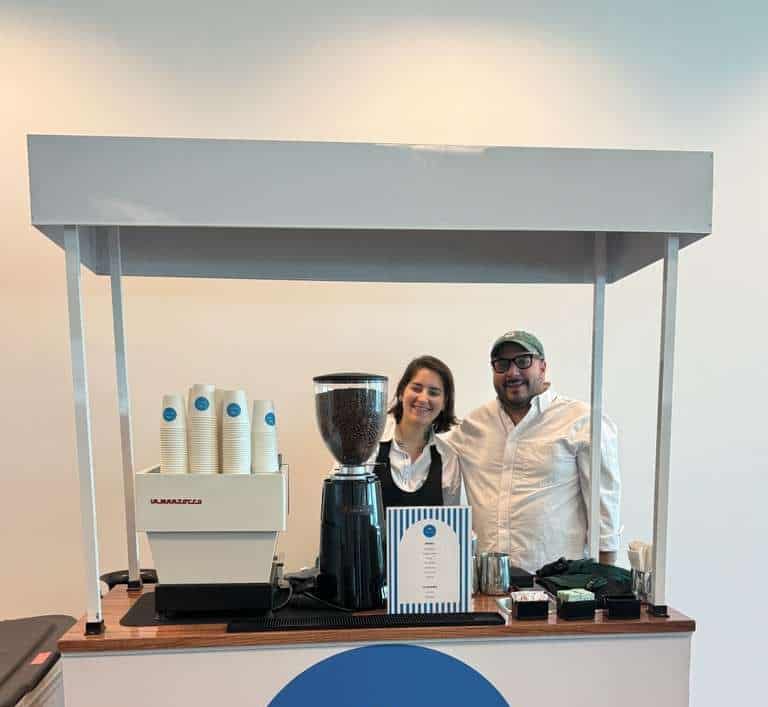
A mobile coffee bar normally includes commercial equipment, transportation, setup, breakdown, baristas, cups, milk, ingredients, and drinks made throughout a service period. Dividing the package price by the number of cups does not capture the entire service.
A guest receiving one latte at an event may represent a much higher apparent per-drink cost than buying from a café. The client is paying to bring the café, equipment, staff, and service directly to the venue.
For that reason, coffee-shop menu prices and coffee cart catering prices should not be compared as if they were identical products. If you want the real numbers, here is how much it costs to rent a coffee cart for an event.
Event pricing also depends on your guest count and how much your guests actually drink. Our guide covers how much coffee you need for 50 guests and larger groups, so you can size the service before you compare quotes. You can also see our standard packages on the pricing page.

What Is a Reasonable Amount to Spend on Coffee?
A reasonable price depends on what you value:
- Lowest cost: Make drip or instant coffee at home for approximately $0.10 to $0.50.
- Convenience: Expect to spend $2 to $4 at a gas station, fast-food restaurant, or basic café.
- Coffee-shop experience: Approximately $4 to $7 is normal.
- Specialty preparation: Approximately $5 to $10 can be reasonable.
- Luxury or novelty drink: Expect $8 to $12 or more.
For an ordinary latte, around $5 to $6 is currently normal. A price below $4 is inexpensive, while a price above $7 should generally come with a larger size, expensive ingredients, unusual coffee, or an experience the customer values.
Frequently Asked Questions
Is $5 a lot for a coffee?
For a latte or cappuccino, $5 is normal and sits toward the lower end of the usual $4.50 to $6.50 range. For a plain brewed coffee, $5 is on the higher side, and customers may expect better beans, a larger serving, an expensive location, or a carefully prepared single-origin coffee.
Why is coffee so expensive right now?
International coffee prices rose nearly 40% during 2024 because of weather-related supply disruptions and reached historic highs in early 2025. By August 2026, retail coffee prices were 6.1% higher than a year earlier. Cafés also pay for wages, rent, utilities, equipment, milk, cups, payment fees, insurance, and waste.
How much cheaper is it to make coffee at home?
Standard ground coffee at home costs about $0.20 to $0.50 per cup, compared with $3 to $4.50 for the same drink at a café. Specialty beans run about $0.60 to $1.50 per cup, and pods cost about $0.40 to $1.50. None of those figures include the machine, grinder, electricity, or your time.
What is the average price of a latte in the United States?
A normal latte costs approximately $4.50 to $6.50. Toast’s coffee pricing analysis found an average latte price of approximately $5.60 and an average macchiato price of $5.11.
Why does coffee catering cost more per cup than a coffee shop?
A mobile coffee bar includes commercial equipment, transportation, setup, breakdown, baristas, cups, milk, ingredients, and drinks served throughout a service period. Dividing the package price by the number of cups does not capture the entire service, because the client is paying to bring the café to the venue.
Planning coffee for an event in South Florida?
Cafering brings a full espresso bar, trained baristas, and specialty drinks to your venue in Miami, Fort Lauderdale, Boca Raton, West Palm Beach, and Naples.
Get a quote
